
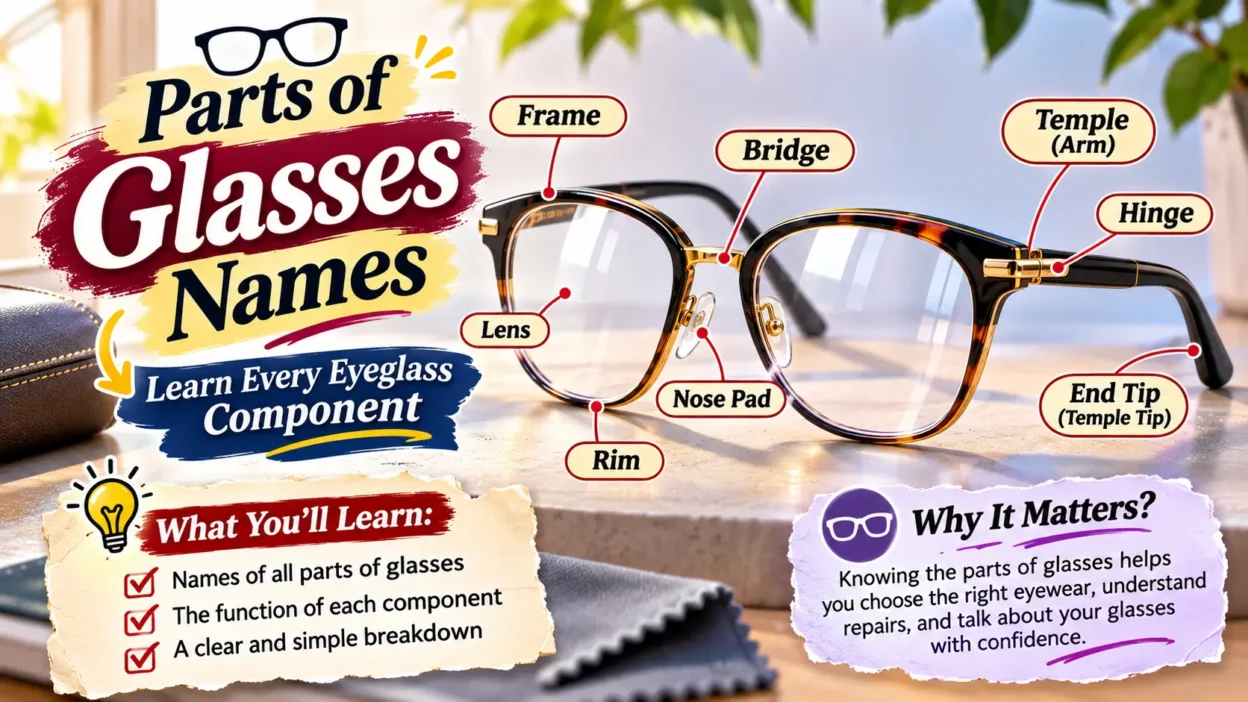
Parts of glasses names help you understand every small detail of your eyewear. Whether you wear prescription glasses or stylish sunglasses, knowing these components makes a difference. You can identify frame pieces, lens features, nose pads, hinges, and other important details. Each component plays a role in comfort, appearance, durability, or vision correction. Some parts hold the glasses together, while others help them fit your face properly. Even a tiny screw can affect how securely your glasses sit.
Understanding eyeglass anatomy also makes shopping and repairs much easier. For example, you can explain exactly which component needs replacement. You can also communicate better with an optician when adjusting your frames. This guide explores different eyeglass components and related eyewear terminology. It covers frame fronts, bridges, temples, lenses, coatings, materials, and accessories. You’ll also discover useful terms associated with frame shapes and measurements. Whether you’re a beginner or an experienced glasses wearer, this resource makes the terminology easier to understand. Let’s explore the different parts of glasses names and build a better understanding of everyday eyewear.
👓 What Are the Main Parts of Glasses Called?
The main parts of glasses include the frame, lenses, bridge, temples, hinges, and nose pads. These components work together to provide a comfortable fit and clear vision.
Most eyeglasses contain a front frame, two lenses, and two side arms. Additional hardware keeps everything secure and properly aligned.
🖼️ Complete Parts of Glasses Names for Frame Components
The frame gives eyeglasses their overall structure and appearance. Its front section supports the lenses and connects with the side arms. Here are frame-related terms and structural features used across different eyewear designs.
- Frame front
- Front chassis
- Frame rim
- Lens rim
- Upper rim
- Lower rim
- Outer rim
- Inner rim
- Full rim
- Half rim
- Rimless mount
- Semi rim
- Browline frame
- Brow bar
- Brow piece
- Brow accent
- Top bar
- Bottom bar
- Center frame
- Frame edge
- Rim edge
- Lens groove
- Lens channel
- Bezel edge
- Eyewire groove
- Eyewire channel
- Frame opening
- Lens opening
- Eye wire
- Frame bridge
- End piece
- Endpiece joint
- Hinge plate
- Temple joint
- Frame corner
- Outer corner
- Inner corner
- Frame contour
- Front contour
- Rim contour
- Frame profile
- Front profile
- Frame surface
- Outer surface
- Inner surface
- Frame finish
- Matte finish
- Gloss finish
- Satin finish
- Polished finish
- Frame coating
- Color finish
- Frame detailing
- Decorative insert
- Metal accent
- Frame inlay
- Logo plaque
- Brand emblem
- Logo engraving
- Frame engraving
- Temple logo
- Front emblem
- Frame molding
- Molded front
- Cast frame
- Injection frame
- Frame laminate
- Layered acetate
- Frame overlay
- Frame insert
- Frame reinforcement
- Frame support
- Frame alignment
- Frame symmetry
- Frame curvature
- Front curvature
- Frame thickness
- Rim thickness
- Frame width
- Front width
- Frame height
- Bridge position
- Lens position
- Frame center
- Frame silhouette
🌉 Parts of Glasses Names for Bridges and Nose Supports
The bridge connects the two lens areas across the nose. Nose pads and other supporting features help distribute the frame’s weight. These terms cover bridge designs, nose supports, and related fitting components.
- Saddle bridge
- Keyhole bridge
- Adjustable bridge
- Fixed bridge
- Double bridge
- Raised bridge
- Low bridge
- Flat bridge
- Sculpted bridge
- Curved bridge
- Straight bridge
- Narrow bridge
- Wide bridge
- Metal bridge
- Acetate bridge
- Plastic bridge
- Titanium bridge
- Integrated bridge
- Molded bridge
- Floating bridge
- Suspension bridge
- Bridge saddle
- Bridge arch
- Bridge curve
- Bridge span
- Bridge width
- Bridge height
- Bridge angle
- Bridge contour
- Bridge support
- Bridge fitting
- Bridge insert
- Bridge connector
- Bridge plate
- Bridge bar
- Center bridge
- Nose saddle
- Nose support
- Nose pad
- Nose cushion
- Nose rest
- Nose piece
- Nose contact
- Nose fitting
- Nose grip
- Nose cradle
- Nose support arm
- Nose pad arm
- Pad arm
- Pad holder
- Pad bracket
- Pad mount
- Pad screw
- Pad socket
- Pad joint
- Pad stem
- Pad base
- Pad surface
- Pad cushion
- Pad backing
- Pad insert
- Pad attachment
- Pad connector
- Pad alignment
- Pad adjustment
- Pad spacing
- Pad angle
- Pad height
- Pad width
- Pad thickness
- Silicone pad
- Rubber pad
- Plastic pad
- PVC pad
- Air cushion
- Soft nosepiece
- Saddle support
- Bridge cushion
- Nose grip pad
- Screw-in pad
- Clip-on pad
- Snap-in pad
- Push-in pad
➡️ Eyeglass Temple Parts and Side Arm Names
Temples are the two side arms that extend from the frame toward your ears. They help keep eyeglasses securely positioned throughout the day. Their tips, joints, and adjustment features contribute to a comfortable fit.
- Right temple
- Left temple
- Temple arm
- Side arm
- Temple tip
- Temple end
- Temple shaft
- Temple body
- Temple front
- Temple base
- Temple hinge
- Temple joint
- Temple curve
- Temple bend
- Temple angle
- Temple length
- Temple width
- Temple thickness
- Temple contour
- Temple profile
- Temple surface
- Temple finish
- Temple coating
- Temple insert
- Temple inlay
- Temple overlay
- Temple accent
- Temple emblem
- Temple logo
- Temple engraving
- Temple decoration
- Temple pattern
- Temple texture
- Temple core
- Temple wire
- Temple reinforcement
- Temple support
- Temple extension
- Temple connector
- Temple attachment
- Temple alignment
- Temple adjustment
- Temple fitting
- Temple curvature
- Temple taper
- Temple transition
- Ear stem
- Ear arm
- Ear hook
- Ear curve
- Ear bend
- Ear grip
- Ear rest
- Ear contact
- Ear support
- Ear cushion
- Ear sleeve
- Ear cover
- Ear protector
- Rubber temple tip
- Silicone temple tip
- Acetate temple tip
- Plastic temple tip
- Metal temple tip
- Curved temple tip
- Straight temple tip
- Flexible temple tip
- Adjustable temple tip
- Wrapped temple tip
- Paddle temple
- Cable temple
- Skull temple
- Riding temple
- Spring temple
- Flexible temple
- Hinged temple
- Straight temple
- Curved temple
- Slim temple
- Wide temple
- Thick temple
- Thin temple
- Featherweight temple
- Memory temple
- Foldable temple
🔩 Eyeglass Hinge Parts and Frame Fasteners
Hinges connect the temples to the front frame. Screws, barrels, and small connectors help keep the moving sections together. These terms cover common hinge styles and hardware used in eyeglass construction.
- Standard hinge
- Spring hinge
- Barrel hinge
- Five barrel
- Three barrel
- Two barrel
- Hidden hinge
- Flush hinge
- Riveted hinge
- Screw hinge
- Flex hinge
- Metal hinge
- Titanium hinge
- Stainless hinge
- Integrated hinge
- Concealed hinge
- External hinge
- Internal hinge
- Hinge barrel
- Hinge pin
- Hinge plate
- Hinge leaf
- Hinge arm
- Hinge joint
- Hinge screw
- Hinge post
- Hinge base
- Hinge block
- Hinge socket
- Hinge bracket
- Hinge connector
- Hinge attachment
- Hinge alignment
- Hinge tension
- Hinge movement
- Hinge rotation
- Hinge opening
- Hinge closing
- Hinge spring
- Spring mechanism
- Spring coil
- Spring insert
- Spring tension
- Spring housing
- Spring connector
- Spring arm
- Spring joint
- Spring barrel
- Spring pin
- Frame screw
- Temple screw
- Hinge screw
- Pad screw
- Rim screw
- Mounting screw
- Locking screw
- Micro screw
- Screw head
- Screw thread
- Screw shaft
- Screw tip
- Screw length
- Screw diameter
- Screwdriver slot
- Screw anchor
- Screw socket
- Screw washer
- Lock nut
- Small nut
- Metal washer
- Screw insert
- Thread insert
- Thread lock
- Screw fitting
- Screw mount
- Screw joint
- Screw connector
- Rivet pin
- Metal rivet
- Rivet head
- Rivet joint
- Rivet plate
- Frame pin
- Hinge pin
- Locking pin
- Pivot pin
- Connector pin
🔍 Eyeglass Lens Parts and Optical Surface Names
Lenses are the most important optical components of prescription glasses. Their surfaces, edges, centers, and optical zones influence how you see. The following collection includes lens anatomy and common optical terminology.
- Right lens
- Left lens
- Front surface
- Back surface
- Outer surface
- Inner surface
- Convex surface
- Concave surface
- Aspheric surface
- Spherical surface
- Optical surface
- Lens center
- Optical center
- Geometric center
- Visual center
- Lens edge
- Lens bevel
- Lens groove
- Lens notch
- Lens cutout
- Lens contour
- Lens curve
- Lens thickness
- Center thickness
- Edge thickness
- Lens diameter
- Lens width
- Lens height
- Lens shape
- Lens profile
- Lens curvature
- Base curve
- Back curve
- Front curve
- Lens power
- Optical power
- Focal point
- Focal length
- Optical axis
- Visual axis
- Principal meridian
- Lens aperture
- Clear aperture
- Optical zone
- Distance zone
- Near zone
- Intermediate zone
- Reading zone
- Distance segment
- Near segment
- Bifocal segment
- Trifocal segment
- Progressive corridor
- Progressive zone
- Transition zone
- Peripheral zone
- Central zone
- Reading area
- Distance area
- Intermediate area
- Lens segment
- Segment line
- Segment height
- Segment width
- Lens alignment
- Lens positioning
- Lens orientation
- Lens mounting
- Lens fitting
- Lens edging
- Lens polishing
- Lens beveling
- Lens drilling
- Lens grooving
- Lens chamfer
- Lens notch
- Lens cut
- Lens rim
- Lens retention
- Lens seating
- Lens support
- Lens holder
- Lens insert
- Lens coating
- Lens treatment
- Lens finish
✨ Eyeglass Lens Coatings and Surface Treatments
Lens coatings improve the performance and appearance of eyewear. Some reduce reflections, while others protect surfaces or improve visual comfort. These related terms cover popular lens treatments and specialized optical finishes.
- Anti-reflective coating
- Anti-glare coating
- Scratch-resistant coating
- Hard coating
- Hydrophobic coating
- Oleophobic coating
- UV coating
- UV protection
- Blue light coating
- Blue light filter
- Photochromic treatment
- Polarized treatment
- Mirror coating
- Flash mirror
- Gradient coating
- Tinted coating
- Clear coating
- Multilayer coating
- Broadband coating
- Broadband protection
- Superhydrophobic coating
- Water-repellent coating
- Oil-repellent coating
- Smudge-resistant coating
- Dust-resistant coating
- Anti-static coating
- Fog-resistant coating
- Anti-fog treatment
- UV400 protection
- UV-A protection
- UV-B protection
- UV-C protection
- Infrared protection
- Blue-violet filter
- Blue-turquoise filter
- Digital protection
- Glare reduction
- Reflection reduction
- Light transmission
- Light filtering
- Contrast enhancement
- Color enhancement
- Polarized filter
- Polarizing film
- Polarizing layer
- Photochromic layer
- Transition lens
- Adaptive tint
- Variable tint
- Gradient tint
- Solid tint
- Gray tint
- Brown tint
- Green tint
- Yellow tint
- Rose tint
- Blue tint
- Amber tint
- Copper tint
- Pink tint
- Purple tint
- Orange tint
- Mirror finish
- Silver mirror
- Gold mirror
- Blue mirror
- Green mirror
- Red mirror
- Bronze mirror
- Flash finish
- Matte finish
- Gloss finish
- Anti-smudge finish
- Water-shedding finish
- Scratch protection
- Surface protection
- Hardening layer
- Protective layer
- Optical laminate
- Coating thickness
- Coating durability
- Surface treatment
- Lens treatment
- UV filtering
- Glare control
- Reflection control
🧪 Eyeglass Lens Materials and Optical Types
Eyeglass lenses come in different materials and optical designs. Each option offers different characteristics, including weight, clarity, thickness, and impact resistance. These terms cover common lens materials and specialized lens types.
- Crown glass
- Optical glass
- Mineral glass
- CR-39 plastic
- Polycarbonate lens
- Trivex lens
- High-index lens
- Mid-index lens
- Standard plastic
- Acrylic lens
- Nylon lens
- Tribrid material
- Resin lens
- Plastic resin
- Glass lens
- Organic lens
- Aspheric lens
- Spherical lens
- Biconvex lens
- Biconcave lens
- Plano lens
- Single-vision lens
- Bifocal lens
- Trifocal lens
- Progressive lens
- Multifocal lens
- Reading lens
- Distance lens
- Computer lens
- Office lens
- Occupational lens
- Safety lens
- Sports lens
- Driving lens
- Sunglass lens
- Polarized lens
- Photochromic lens
- Transition lens
- Tinted lens
- Clear lens
- Gradient lens
- Mirrored lens
- Blue-filter lens
- UV-blocking lens
- Anti-fatigue lens
- Prism lens
- Fresnel lens
- Lenticular lens
- Aphakic lens
- Toric lens
- Freeform lens
- Digital lens
- Customized lens
- Prescription lens
- Nonprescription lens
- Plano sunglasses
- Corrective lens
- Therapeutic lens
- Magnifying lens
- Occupational bifocal
- Executive bifocal
- Flat-top bifocal
- Round-segment bifocal
- Blended bifocal
- D-segment lens
- Crossover lens
- Progressive addition
- Short-corridor progressive
- Long-corridor progressive
- Standard progressive
- Premium progressive
- Personalized progressive
- High-definition lens
- Wavefront lens
- Aspheric progressive
- Double-aspheric lens
- Lenticular design
- Slab-off lens
- Prism correction
- Base-in prism
- Base-out prism
- Base-up prism
- Base-down prism
- Reading addition
- Distance prescription
- Near prescription
🪵 Eyeglass Frame Materials and Construction Terms
Frame materials influence durability, flexibility, comfort, and overall appearance. Manufacturers use different metals, plastics, and natural materials to create distinctive eyewear. These terms cover popular construction materials and frame finishes.
- Acetate frame
- Cellulose acetate
- Propionate frame
- Optyl frame
- Nylon frame
- TR90 frame
- Polyamide frame
- Polycarbonate frame
- Acrylic frame
- Injection plastic
- Molded plastic
- Bio-acetate
- Plant-based acetate
- Recycled acetate
- Eco-acetate
- Stainless steel
- Surgical steel
- Titanium frame
- Beta titanium
- Pure titanium
- Memory metal
- Flexon metal
- Monel metal
- Nickel silver
- Aluminum frame
- Magnesium frame
- Beryllium metal
- Copper alloy
- Brass frame
- Bronze frame
- Gold alloy
- Sterling silver
- Carbon fiber
- Carbon composite
- Fiberglass composite
- Wood frame
- Bamboo frame
- Walnut wood
- Ebony wood
- Maple wood
- Rosewood frame
- Cork material
- Horn material
- Buffalo horn
- Natural horn
- Leather detail
- Silicone frame
- Rubber frame
- Flexible polymer
- Thermoplastic material
- Thermoset plastic
- Polymer composite
- Metal alloy
- Lightweight alloy
- Titanium alloy
- Stainless alloy
- Plastic composite
- Laminated acetate
- Layered plastic
- Transparent acetate
- Colored acetate
- Patterned acetate
- Marble acetate
- Tortoiseshell acetate
- Matte acetate
- Glossy acetate
- Brushed metal
- Polished metal
- Satin metal
- Anodized aluminum
- Powder-coated metal
- Gold plating
- Silver plating
- Chrome plating
- Metal plating
- Rubber coating
- Silicone coating
- Resin coating
- Protective lacquer
- Electroplated finish
- Hand-polished acetate
- Molded polymer
- Reinforced polymer
- Flexible alloy
- Spring steel
- Titanium wire
- Stainless wire
💎 Eyeglass Frame Shapes and Design Names
Frame shapes influence the overall appearance of glasses. They also help shoppers find styles that match their personal preferences. This collection includes popular frame silhouettes and design-related terminology.
- Round frames
- Oval frames
- Square frames
- Rectangle frames
- Rectangular frames
- Cat-eye frames
- Butterfly frames
- Aviator frames
- Pilot frames
- Wayfarer frames
- Browline frames
- Clubmaster frames
- Geometric frames
- Hexagonal frames
- Octagonal frames
- Polygonal frames
- Round wireframes
- Oval wireframes
- Square wireframes
- Rimless frames
- Semi-rimless frames
- Full-rim frames
- Oversized frames
- Small frames
- Narrow frames
- Wide frames
- Slim frames
- Thick frames
- Bold frames
- Minimalist frames
- Vintage frames
- Retro frames
- Classic frames
- Modern frames
- Contemporary frames
- Futuristic frames
- Architectural frames
- Sculptural frames
- Angular frames
- Curved frames
- Soft-square frames
- Rounded-square frames
- Rectangular acetate
- Round acetate
- Square acetate
- Metal aviators
- Double-bridge frames
- Single-bridge frames
- Keyhole frames
- Flat-top frames
- Top-bar frames
- Brow-bar frames
- Shield frames
- Wraparound frames
- Sport frames
- Performance frames
- Racing frames
- Cycling frames
- Running frames
- Safety frames
- Industrial frames
- Folding frames
- Flexible frames
- Clip-on frames
- Magnetic frames
- Convertible frames
- Three-piece frames
- Two-piece frames
- Half-eye frames
- Reading frames
- Executive frames
- Designer frames
- Luxury frames
- Fashion frames
- Statement frames
- Transparent frames
- Clear frames
- Tinted frames
- Colored frames
- Patterned frames
- Tortoiseshell frames
- Crystal frames
- Translucent frames
- Flat-front frames
- Curved-front frames
📏 Eyeglass Measurements and Fitting Terminology
Proper measurements help eyeglasses sit comfortably and maintain correct lens positioning. Opticians consider frame width, bridge size, temple length, and other fitting details. These terms are useful when buying replacement frames or adjusting your current pair.
- Frame width
- Lens width
- Lens height
- Bridge width
- Temple length
- Arm length
- Total width
- Front width
- Vertical height
- Horizontal width
- Eye size
- Boxing system
- A measurement
- B measurement
- DBL measurement
- Effective diameter
- Minimum blank size
- Pupillary distance
- Monocular distance
- Binocular distance
- Near pupillary distance
- Distance PD
- Segment height
- Fitting height
- Optical center
- Optical centration
- Frame centration
- Vertex distance
- Back vertex distance
- Pantoscopic tilt
- Face form angle
- Wrap angle
- Frame tilt
- Bridge fit
- Temple fit
- Nose fit
- Ear fit
- Frame balance
- Weight distribution
- Lens alignment
- Eye alignment
- Frame symmetry
- Temple pressure
- Nose pressure
- Ear pressure
- Bridge clearance
- Cheek clearance
- Eyelash clearance
- Brow clearance
- Frame spacing
- Lens spacing
- Pad spacing
- Temple spread
- Hinge spread
- Frame adjustment
- Temple adjustment
- Nose adjustment
- Pad adjustment
- Bridge adjustment
- Frame leveling
- Temple leveling
- Lens leveling
- Frame stability
- Frame positioning
- Frame placement
- Frame height
- Frame depth
- Bridge height
- Nose width
- Face width
- Head width
- Temple angle
- Temple curve
- Bridge angle
- Lens angle
- Frame curvature
- Face curvature
- Base curve
- Wrap curvature
- Lens decentration
- Optical decentration
- Horizontal decentration
- Vertical decentration
- Frame tolerance
- Fitting tolerance
- Alignment tolerance
- Nose clearance
- Ear clearance
- Side clearance
- Frame pressure
- Frame comfort
🧰 Eyeglass Accessories and Replacement Component Names
Eyeglasses need occasional maintenance to stay comfortable and secure. Replacement accessories can help restore damaged frames or improve everyday use. These terms cover useful add-ons, repair items, and storage accessories.
- Eyeglass case
- Hard case
- Soft case
- Folding case
- Magnetic case
- Leather case
- Zipper case
- Travel case
- Protective pouch
- Microfiber pouch
- Cleaning cloth
- Microfiber cloth
- Lens cleaner
- Cleaning spray
- Cleaning solution
- Lens wipes
- Anti-fog wipes
- Cleaning brush
- Frame brush
- Lens tissue
- Eyeglass chain
- Glasses chain
- Beaded chain
- Metal chain
- Gold chain
- Silver chain
- Retainer strap
- Sports strap
- Silicone strap
- Elastic strap
- Neoprene strap
- Floating strap
- Eyewear cord
- Glasses cord
- Neck cord
- Temple cord
- Chain connector
- Cord connector
- Strap connector
- Rubber retainer
- Temple sleeve
- Temple cover
- Ear grip
- Anti-slip sleeve
- Nose pad kit
- Replacement pads
- Silicone pads
- Screw kit
- Repair kit
- Eyeglass screwdriver
- Precision screwdriver
- Mini screwdriver
- Screw replacement
- Hinge replacement
- Hinge repair
- Temple replacement
- Frame replacement
- Lens replacement
- Replacement lens
- Lens holder
- Lens suction cup
- Lens insertion tool
- Lens removal tool
- Frame warmer
- Adjustment pliers
- Nose pad pliers
- Temple pliers
- Optical tweezers
- Frame alignment tool
- Lens edging tool
- Lens polishing wheel
- Screw extractor
- Thread repair tool
- Ultrasonic cleaner
- Cleaning station
- Lens protector
- Lens cover
- Sun clip
- Magnetic clip
- Flip-up clip
- Polarized clip
- Prescription clip
- Side shields
- Safety shields
- Dust shields
- Sports attachment
- Night driving clip
- Reading attachment
- Lens tint
- Frame decal
- Decorative charm
- Eyeglass holder
- Desk holder
- Wall holder
- Car visor clip
- Bedside holder
🕶️ Different Types of Eyewear and Related Optical Terms
Eyewear includes more than ordinary prescription glasses. Different designs serve vision correction, sun protection, sports, workplace safety, and specialized needs. These terms expand your knowledge of the wider eyewear category.
- Prescription glasses
- Reading glasses
- Distance glasses
- Computer glasses
- Office glasses
- Driving glasses
- Sunglasses
- Polarized sunglasses
- Photochromic glasses
- Blue light glasses
- Safety glasses
- Protective eyewear
- Sports glasses
- Cycling glasses
- Running glasses
- Swimming goggles
- Ski goggles
- Snow goggles
- Motorcycle goggles
- Shooting glasses
- Welding goggles
- Laboratory glasses
- Industrial eyewear
- Medical eyewear
- Children’s glasses
- Toddler glasses
- Baby glasses
- Fashion glasses
- Designer eyewear
- Luxury eyewear
- Vintage eyewear
- Retro eyewear
- Rimless eyewear
- Semi-rimless eyewear
- Full-rim eyewear
- Clip-on sunglasses
- Magnetic sunglasses
- Wraparound sunglasses
- Shield sunglasses
- Aviator sunglasses
- Cat-eye sunglasses
- Round sunglasses
- Square sunglasses
- Oversized sunglasses
- Folding sunglasses
- Mirrored sunglasses
- Gradient sunglasses
- Tinted sunglasses
- Prescription sunglasses
- Sports sunglasses
- Performance eyewear
- Adaptive eyewear
- Low-vision glasses
- Magnifying glasses
- Prismatic glasses
- Trifocal glasses
- Bifocal glasses
- Progressive glasses
- Multifocal glasses
- Aphakic glasses
- Occlusion glasses
- Pinhole glasses
- Prism glasses
- Half-moon glasses
- Half-eye readers
- Safety goggles
- Chemical goggles
- Dust goggles
- Splash goggles
- Impact goggles
- Face shields
- Welding shields
- Motorcycle visors
- Ski visors
- Helmet eyewear
- Night driving glasses
- Computer eyewear
- Gaming glasses
- Anti-fatigue glasses
- Occupational eyewear
- Therapeutic eyewear
- Protective spectacles
- Optical spectacles
- Corrective spectacles
- Fashion spectacles
- Prescription spectacles
- Sun spectacles
- Sports spectacles
- Children’s eyewear
- Adult eyewear
- Unisex eyewear
🧩 Small Eyeglass Components and Specialized Optical Hardware
Small components often receive less attention than frames and lenses. However, they help maintain alignment, stability, and long-term durability. This collection includes specialized hardware and technical terms found in different eyeglass constructions.
- Rim lock
- Locking block
- Lens locking
- Locking screw
- Retaining screw
- Retaining ring
- Lens retainer
- Retaining clip
- Lens clamp
- Lens bracket
- Lens holder
- Mounting bracket
- Mounting plate
- Mounting post
- Mounting pin
- Mounting stud
- Support bracket
- Support plate
- Connector plate
- Connector block
- Joint plate
- Joint block
- Frame anchor
- Temple anchor
- Bridge anchor
- Hinge anchor
- Pad anchor
- Lens anchor
- Screw anchor
- Rivet anchor
- Metal insert
- Threaded insert
- Plastic insert
- Acetate insert
- Reinforcement wire
- Core wire
- Temple core
- Metal core
- Wire core
- Frame core
- Spring wire
- Flex wire
- Hinge wire
- Bridge wire
- Nose wire
- Support wire
- Frame connector
- Temple connector
- Bridge connector
- Lens connector
- Pad connector
- Hinge connector
- Joint connector
- Pivot connector
- Flex connector
- Screw connector
- Locking connector
- Metal sleeve
- Rubber sleeve
- Silicone sleeve
- Plastic sleeve
- Hinge sleeve
- Temple sleeve
- Screw sleeve
- Protective sleeve
- Spacer ring
- Plastic spacer
- Metal spacer
- Hinge spacer
- Lens spacer
- Screw spacer
- Washer spacer
- Pivot washer
- Lock washer
- Flat washer
- Spring washer
- Threaded barrel
- Hinge barrel
- Pivot barrel
- Screw barrel
- Threaded post
- Hinge post
- Mounting post
- Pivot post
- Frame post
- Lens post
- Screw post
- Locking post
- Joint pin
- Pivot pin
- Retaining pin
- Alignment pin
- Mounting pin
- Hinge pin
- Spring pin
- Metal dowel
- Plastic dowel
📚 Essential Eyeglass Anatomy Terms Every Glasses Wearer Should Know
Learning eyewear terminology makes everyday glasses care easier. You can identify common components, understand frame measurements, and discuss repairs confidently. Start with the frame front, lenses, bridge, temples, and hinges. Then learn the smaller features, including nose pads, screws, and temple tips.
Remember that not every pair uses the same construction. Rimless glasses, for example, use different mounting hardware from full-rim frames. Some designs feature integrated nose supports instead of separate pads. Therefore, the exact component names can vary between manufacturers. If you need a replacement part, take your glasses to an optician. They can identify the correct size and compatible hardware.
🔧 How to Identify and Maintain Different Parts of Glasses
Begin by examining the front of your glasses. Look for the two lenses, surrounding rims, and connecting bridge. Next, follow each side arm toward the ear. You should find a hinge near the outer frame corner and a curved temple tip. Check the nose area for pads or an integrated support. Small screws may connect the hinges and nose pad arms.
Regular maintenance helps prevent avoidable damage. Clean your lenses with a microfiber cloth and suitable lens cleaner. Avoid wiping dusty lenses with rough fabric. Tighten loose screws with an appropriate optical screwdriver. Never force a stiff hinge or bend a frame without proper tools. Visit an optician when a component breaks or needs precise adjustment.
🛍️ How to Choose the Right Eyeglass Replacement Parts
Choosing replacement components requires attention to fit and compatibility. Start by identifying the exact frame model and material. A replacement temple must match the original hinge connection. Similarly, nose pads need compatible mounts and suitable dimensions. Lens replacements require accurate measurements and the correct prescription.
Do not choose parts based on appearance alone. Two components may look similar but use different fittings. Ask an optician to inspect the frame before ordering hardware. You can also consult All About Vision for additional eyewear education. For more helpful vocabulary guides, explore our internal article about optical and vision terminology.
❓ Frequently Asked Questions About Parts of Glasses Names
What are the main parts of glasses called?
The main parts include the frame, lenses, bridge, temples, hinges, and nose pads. Some glasses also contain screws, temple tips, and additional support hardware.
What is the middle part of glasses called?
The middle section connecting both lenses is called the bridge. It rests above your nose and helps support the frame.
What are the arms of glasses called?
The arms are commonly called temples or temple arms. They extend from the frame’s outer corners and rest over your ears.
What are the small pads on glasses called?
The small supports resting against your nose are called nose pads. They help distribute the frame’s weight and improve comfort.
What connects the arms to eyeglass frames?
Hinges connect the temples to the front frame. Small screws or other fastening mechanisms secure these connections.
What is the front part of glasses called?
The front section is commonly called the frame front or front chassis. It holds both lenses and connects to the temples.
What is the difference between eyeglass rims and frames?
The frame refers to the complete supporting structure of the glasses. Rims are the sections surrounding and holding the lenses in full-rim designs.
Can I replace individual parts of my glasses?
Yes, many eyeglass components can be replaced separately. Common replacements include nose pads, screws, temples, hinges, and lenses. An optician can confirm compatibility and complete the repair safely.
❤️ Conclusion
Understanding parts of glasses names makes eyewear easier to identify, maintain, and repair. From lenses and bridges to temples and tiny screws, every component has a role. Learning these terms also helps you communicate with opticians and choose suitable replacement parts. Remember that different frame designs use different construction methods. Therefore, always check compatibility before purchasing replacement components. With this guide, you can recognize common eyeglass parts and understand the terminology behind everyday eyewear. A little knowledge can make caring for your glasses much easier.

Claire Anderson is a language writer and naming enthusiast who creates clear, well-researched content on names, meanings, synonyms, grammar, and vocabulary. She is dedicated to making English easier to understand through accurate and reader-friendly guides.