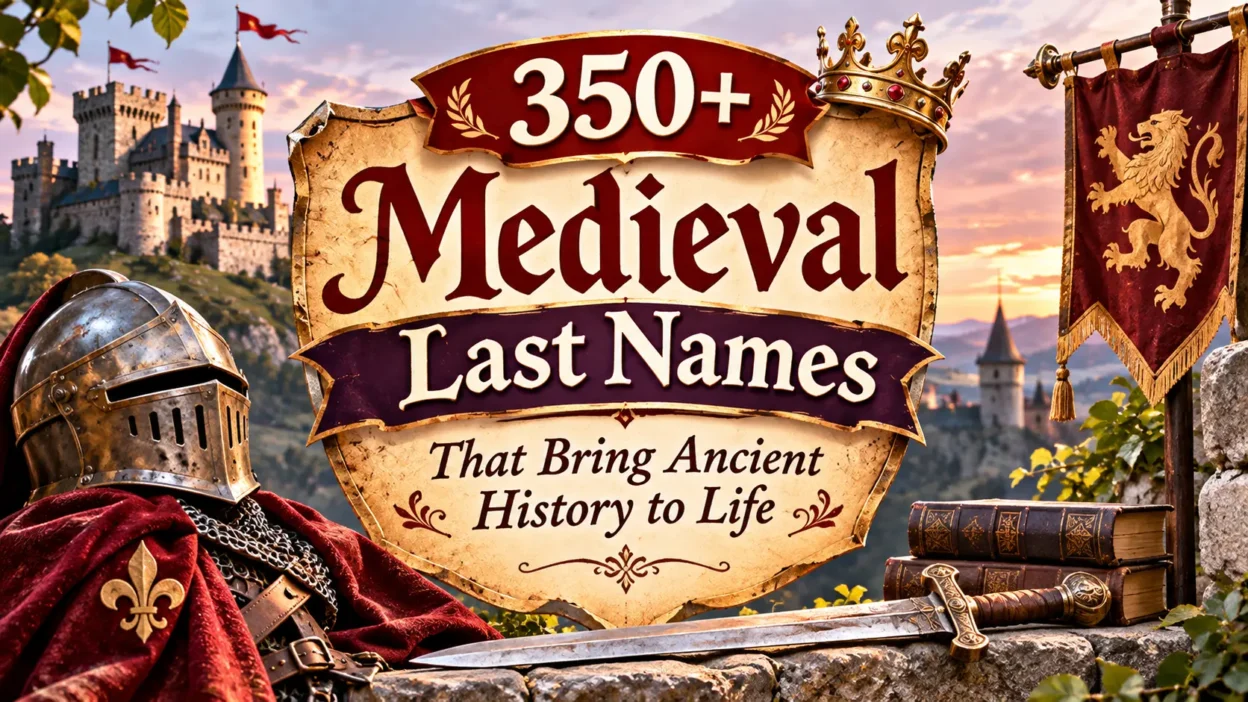
Medieval last names carry a fascinating connection to history, family heritage, ancient traditions, and forgotten kingdoms. These historic surnames reflect the lives of knights, nobles, merchants, farmers, warriors, and ordinary people. From powerful royal family names to humble occupational surnames, each name offers a glimpse into medieval society. Whether you love medieval history or need an unforgettable surname, this collection offers plenty of inspiration. Medieval last names also bring a timeless atmosphere to fictional characters, fantasy stories, role-playing games, and historical writing. They can make a character feel connected to an older world filled with castles, kingdoms, battles, and family legacies.
Choosing the right medieval surname can make a meaningful difference in your creative project. Perhaps you want a noble surname for a royal character, a mysterious family name for a fantasy novel, or an authentic-sounding surname for a historical game. You might also enjoy discovering old English surnames, Norman family names, medieval French surnames, and traditional German last names. This guide brings together different naming styles in one convenient collection. You will discover strong, elegant, rare, aristocratic, and mysterious medieval surnames. Each category offers plenty of choices without repeating names. So, explore these historic family names and find one that captures the personality, background, and atmosphere you have in mind. Let these medieval surnames inspire your next unforgettable character or naming idea.
Which Medieval Last Names Sound Most Historic?
Medieval last names often reflected a person’s occupation, birthplace, family relationship, or physical characteristics. Popular historical styles include occupational surnames such as Smith and Baker, geographical names such as Hill and Wood, and patronymic names such as Johnson and Williamson. Noble families also used surnames connected to estates, castles, and ancestral lands.
Unique Medieval Last Names for Distinctive Family Heritage 🏰
Unique medieval surnames add individuality to historical characters and family histories. These uncommon old-world family names suit creative writing, fantasy settings, and historical storytelling.
- Ainsworth
- Aldridge
- Ashcombe
- Ashford
- Athelstan
- Audley
- Aveline
- Bancroft
- Beaumont
- Beckett
- Belgrave
- Beresford
- Blackwood
- Blakely
- Boleyn
- Brackenbury
- Bramwell
- Branscombe
- Brantley
- Brereton
- Briarwood
- Bridgeman
- Broadbent
- Bromley
- Buckland
- Burghley
- Calderwood
- Camberwell
- Catesby
- Charnwood
- Chatham
- Chetwynd
- Clavering
- Coldwell
- Compton
- Corbett
- Cresswell
- Cromwell
- Darnley
- Davenant
- Devereux
- Digby
- Dinsmore
- Dorrington
- Draycott
- Duncombe
- Eastwood
- Ellesmere
- Everard
- Fairchild
- Faringdon
- Fenwick
- Fitzalan
- Fitzherbert
- Fitzhugh
- Fitzroy
- Fleetwood
- Fortescue
- Gillingham
- Golding
- Goodwin
- Grantham
- Greville
- Grimshaw
- Haddington
- Hargreaves
- Harwood
- Hatherley
- Hawthorne
- Henshaw
- Hervey
- Hesketh
- Highmore
- Hollingsworth
- Huxley
- Inglewood
- Islington
- Jermyn
- Kellington
Noble Medieval Last Names for Aristocratic Families 👑
Noble medieval last names create an atmosphere of royal heritage, aristocratic ancestry, and historic prestige. These surnames work beautifully for fictional lords, noble houses, queens, kings, and influential medieval families.
- Arundel
- Ashburnham
- Abergavenny
- Basset
- Beauchamp
- Bohun
- Braose
- Burgh
- Burghersh
- Butler
- Carew
- Cavendish
- Chandos
- Clifford
- Courtenay
- Courteney
- Darcy
- De Clare
- De Courcy
- De Lacy
- De Mowbray
- De Montfort
- De Quincy
- De Ros
- De Warenne
- Despenser
- Dacre
- Ferrers
- Fitzwalter
- Fitzwilliam
- Giffard
- Gournay
- Grey
- Hastings
- Herbert
- Holland
- Howard
- Hungerford
- Lacy
- Lancaster
- Latimer
- L’Isle
- Lovel
- Lucy
- Maltravers
- Mandeville
- Marmion
- Marshal
- Mortimer
- Mowbray
- Neville
- Northumberland
- Percy
- Plantagenet
- Pole
- Radcliffe
- Redvers
- Ros
- Scrope
- Segrave
- Stafford
- Talbot
- Tewkesbury
- Tiptoft
- Trussell
- Umfraville
- Vere
- Vaux
- Wake
- Waldegrave
- Warwick
- Welles
- Willoughby
- Wodehouse
- Woodville
- Wycliffe
- Zouche
- FitzOsbern
Strong Medieval Last Names for Warriors and Knights ⚔️
Strong medieval surnames evoke courage, battlefield honor, military traditions, and fearless knights. These powerful family names suit warrior characters, medieval heroes, castle guards, and legendary fictional fighters.
- Armstrong
- Battle
- Beauchamp
- Bellamy
- Blount
- Bolden
- Bowman
- Bradford
- Breakspear
- Brigham
- Brock
- Brune
- Carrick
- Castleton
- Chivalry
- Claymore
- Colville
- Corbin
- Crawford
- Crusader
- Daunt
- Drummond
- Edgeworth
- Evers
- Falconer
- Fane
- Farrow
- Fawkes
- Fielding
- Fitzjames
- Fletcher
- Forrester
- Galloway
- Garrick
- Gascoyne
- Garrison
- Godfrey
- Graham
- Granville
- Griffin
- Hardwick
- Hardy
- Harcourt
- Hawkwood
- Hayward
- Hildred
- Hume
- Hunter
- Ironmonger
- Jagger
- Kelsey
- Kincaid
- Kingsley
- Knight
- Langley
- Latham
- Lawrence
- Longford
- Lovett
- Maclean
- Mainwaring
- Markham
- Montgomery
- Morland
- Musgrave
- North
- Oakley
- Palmer
- Parr
- Pembroke
- Ransom
- Severe
- Seymour
- Strong
- Sturdy
- Swinton
- Trenchard
- Waring
- Westmoreland
Old English Medieval Last Names with Historic Charm 📜
Old English surnames bring traditional British heritage and a distinctive medieval atmosphere to family names. These choices draw inspiration from English places, occupations, landscapes, and traditional surname patterns.
- Atwood
- Baker
- Baldwin
- Barker
- Barrow
- Baxter
- Bell
- Bentley
- Birch
- Black
- Blake
- Brewer
- Bridge
- Brown
- Butcher
- Carpenter
- Carter
- Chandler
- Chapman
- Clark
- Clarke
- Cook
- Cooper
- Cowley
- Cross
- Dale
- Dean
- Dyer
- Eaton
- Elder
- Farmer
- Fisher
- Fletcher
- Ford
- Fowler
- Freeman
- Fuller
- Gardiner
- Gardner
- Glover
- Goldsmith
- Green
- Greenwood
- Hall
- Hammond
- Harper
- Harris
- Harrison
- Haynes
- Hill
- Holmes
- Hughes
- Jackson
- Johnson
- Jones
- King
- Lamb
- Lane
- Mason
- Miller
- Mills
- Moore
- Newman
- Page
- Parker
- Payne
- Pearson
- Potter
- Reed
- Shepherd
- Smith
- Spencer
- Taylor
- Turner
- Walker
- Ward
- Webb
- White
- Wright
Rare Medieval Last Names for Uncommon Characters 🕯️
Rare medieval surnames can give fictional families a distinctive identity. They suit unusual characters, forgotten dynasties, historical mysteries, and imaginative medieval worlds.
- Acland
- Adlington
- Altham
- Amcotts
- Annesley
- Apperley
- Arblaster
- Arkwright
- Askew
- Atherstone
- Bagot
- Banastre
- Bardolf
- Barlowe
- Barningham
- Bellingham
- Berington
- Berwick
- Bickersteth
- Blundell
- Boteler
- Broughton
- Bulkeley
- Calverley
- Calthorpe
- Carleton
- Chaworth
- Cholmondeley
- Cokayne
- Collyer
- Conyers
- Copley
- Crewe
- Curwen
- Dallingridge
- Danvers
- D’Eyncourt
- Deincourt
- Delamere
- Dering
- D’Evereux
- D’Oyly
- Dymoke
- Echyngham
- Edgcumbe
- Englefield
- Erpingham
- Esturmy
- Fiennes
- Fitzhugh
- Fitzurse
- Foliot
- Freville
- Gresley
- Hales
- Hamelyn
- Harington
- Harsnett
- Heneage
- Hoby
- Hotham
- Ilbert
- Ireton
- Knyvet
- Kyme
- Lascelles
- Lenthall
- Lutterell
- Maunsell
- Mompesson
- Monthermer
- Munchensy
- Peverel
- Poynings
- Poyntz
- Rokesley
- Somerville
- Stourton
- Throckmorton
Medieval French Last Names with Elegant Heritage 🌹
Medieval French surnames bring elegance, romance, and European historical character. These family names suit noble characters, French-inspired fantasy kingdoms, historical fiction, and aristocratic households.
- Aubert
- Aubry
- Aumont
- Bailly
- Barbier
- Barre
- Baudry
- Beaumont
- Bellanger
- Benoit
- Bernard
- Bertin
- Blanc
- Blanchard
- Bonnet
- Boucher
- Bouchet
- Bourgeois
- Bourdon
- Breton
- Brunet
- Caron
- Cartier
- Charpentier
- Chastain
- Chevalier
- Cloutier
- Collin
- Cordier
- Coste
- Courtois
- D’Aubigny
- D’Artois
- D’Aumale
- Delacroix
- Delattre
- Delorme
- Deschamps
- Desmarais
- Dubois
- Dufour
- Dumont
- Dupont
- Durand
- Fabre
- Faure
- Fontaine
- Fournier
- Garnier
- Gautier
- Girard
- Giraud
- Guérin
- Guillaume
- Guyot
- Hardy
- Hubert
- Jacques
- Lambert
- Laurent
- Lefebvre
- Leroy
- Lemaire
- Marchand
- Martin
- Mercier
- Moreau
- Moulin
- Nicolas
- Noel
- Olivier
- Pascal
- Perrin
- Petit
- Philippe
- Picard
- Renault
- Richard
- Robert
Medieval German Last Names with Powerful Roots 🛡️
Medieval German surnames offer a strong connection to Central European history. Occupational names, regional family names, and traditional German surname patterns make these choices useful for historical and fantasy characters.
- Adler
- Albrecht
- Bach
- Bauer
- Becker
- Berg
- Berger
- Brandt
- Braun
- Busch
- Dietrich
- Eberhardt
- Engel
- Ernst
- Fischer
- Frank
- Friedrich
- Fuchs
- Geiger
- Gerber
- Geyer
- Graf
- Gross
- Günther
- Hahn
- Hartmann
- Heinrich
- Hermann
- Hoffmann
- Hofmann
- Holz
- Huber
- Jäger
- Kaiser
- Keller
- Koch
- König
- Krämer
- Kraus
- Krüger
- Kuhn
- Lang
- Lehmann
- Lindner
- Ludwig
- Maier
- Mayer
- Meier
- Metzger
- Meyer
- Müller
- Neumann
- Otto
- Pfeiffer
- Richter
- Ritter
- Roth
- Schäfer
- Schiller
- Schmidt
- Schneider
- Scholz
- Schreiber
- Schubert
- Schulz
- Schwarz
- Seidel
- Sommer
- Stein
- Stern
- Vogel
- Wagner
- Weber
- Weiss
- Werner
- Wolf
- Zimmermann
Medieval Italian Last Names with Classic Character 🇮🇹
Italian medieval surnames bring the atmosphere of historic city-states, noble households, merchants, and influential families. These names are excellent for Renaissance-inspired fiction and medieval European settings.
- Alberti
- Alighieri
- Amadei
- Andreotti
- Angeli
- Antonelli
- Aquilani
- Arduini
- Bardi
- Bartoli
- Bellini
- Benedetti
- Bernardi
- Bianchi
- Bonacorsi
- Bonfante
- Bonifacio
- Borghese
- Brancaleone
- Bruni
- Buonaccorsi
- Caffarelli
- Calvi
- Capello
- Capponi
- Caracciolo
- Carli
- Casini
- Cavalcanti
- Cenci
- Cesi
- Chigi
- Colonna
- Contarini
- Corsini
- Della Rovere
- Donati
- Doria
- Este
- Fabbri
- Falconi
- Farnese
- Fieschi
- Fiore
- Gaddi
- Gherardini
- Giordano
- Gonzaga
- Grimaldi
- Guicciardini
- Lamberti
- Lanzi
- Loredan
- Malaspina
- Malatesta
- Mancini
- Manfredi
- Medici
- Montefeltro
- Morosini
- Orsini
- Pallavicini
- Pandolfini
- Pazzi
- Peruzzi
- Piccolomini
- Pitti
- Portinari
- Ricasoli
- Rinaldi
- Salviati
- Sforza
- Spinola
- Strozzi
- Tolomei
- Tornabuoni
- Visconti
- Vitelli
Medieval Scottish and Irish Last Names with Celtic Heritage 🍀
Scottish and Irish medieval surnames add Celtic character and a sense of ancestral history. They work particularly well for Highland warriors, Irish clans, medieval families, and historical fantasy characters.
- Abernethy
- Acheson
- Agnew
- Aiken
- Anderson
- Arbuckle
- Armstrong
- Baillie
- Bannerman
- Barclay
- Beaton
- Bell
- Blair
- Boyd
- Boyle
- Brodie
- Bruce
- Buchanan
- Cameron
- Campbell
- Carmichael
- Chisholm
- Colquhoun
- Comyn
- Cumming
- Cunningham
- Dalrymple
- Davidson
- Douglas
- Drummond
- Dunbar
- Ferguson
- Forbes
- Fraser
- Gordon
- Graham
- Grant
- Hamilton
- Hay
- Henderson
- Home
- Innes
- Irvine
- Johnston
- Kerr
- Kincaid
- Lamont
- Leslie
- Lindsay
- Livingstone
- Logan
- Macarthur
- Macdonald
- Macfarlane
- Mackenzie
- Mackintosh
- Macleod
- Macmillan
- Macpherson
- Maxwell
- McGregor
- Montgomery
- Murray
- Ogilvy
- Oliphant
- Ramsay
- Robertson
- Ross
- Ruthven
- Sinclair
- Skene
- Stewart
- Sutherland
- Wallace
- Watson
- Weir
- Wemyss
- Wishart
Medieval Occupational Last Names from Ancient Trades 🔨
Occupational medieval surnames reveal the everyday working lives of earlier communities. Blacksmiths, bakers, merchants, tailors, and other skilled workers helped shape medieval towns and villages.
- Archer
- Armorer
- Baker
- Barber
- Basketmaker
- Beadle
- Blacksmith
- Bleacher
- Blocker
- Bowyer
- Brewer
- Butcher
- Calder
- Carter
- Chandler
- Chaplain
- Clothier
- Collier
- Cooper
- Cordwainer
- Cornmiller
- Cutler
- Dyer
- Farrier
- Farmer
- Fletcher
- Fuller
- Girdler
- Glasswright
- Glazier
- Goldsmith
- Groom
- Harper
- Hayward
- Hewer
- Hosier
- Hunter
- Joiner
- Limner
- Locksmith
- Lorimer
- Mason
- Mercer
- Miller
- Minstrel
- Minter
- Musicker
- Nailor
- Parchmenter
- Parker
- Peddler
- Pinner
- Plowman
- Potter
- Reeve
- Roper
- Saddler
- Sawyer
- Scrivener
- Shearer
- Shepherd
- Shoemaker
- Slater
- Smith
- Spinner
- Spicer
- Stableman
- Tanner
- Thatcher
- Tiler
- Tinker
- Turner
- Vintner
- Wainwright
- Walker
- Weaver
- Wheelwright
- Woodward
- Wright
Medieval Last Names Inspired by Castles, Places, and Landscapes 🌳
Geographical surnames connect medieval families with their homes, estates, villages, and surrounding landscapes. These location-inspired family names suit travelers, landowners, castle residents, and fictional noble houses.
- Abbey
- Alderley
- Allerton
- Aston
- Ashby
- Ashton
- Aylesbury
- Bagshaw
- Banbury
- Barnard
- Barton
- Beck
- Bedford
- Bellwood
- Beverley
- Blackmore
- Bolton
- Boston
- Bradford
- Bridgwater
- Brighton
- Bristol
- Buckley
- Cambridge
- Carlisle
- Chester
- Coventry
- Croft
- Darby
- Derby
- Devon
- Doncaster
- Dorset
- Durham
- Edgecombe
- Elmsley
- Essex
- Exeter
- Fenton
- Gloucester
- Grimsby
- Hadley
- Hampton
- Hartley
- Hereford
- Kendal
- Kingston
- Lancaster
- Leighton
- Lincoln
- Ludlow
- Manchester
- Marlborough
- Medford
- Newcastle
- Nottingham
- Oxford
- Pennington
- Preston
- Radford
- Richmond
- Ripley
- Salisbury
- Sheffield
- Shrewsbury
- Somerton
- Stamford
- Sutton
- Tamworth
- Tiverton
- Warwick
- Wellington
- Westbury
- Winchester
- Windsor
- York
- Yorkshire
- Worthington
Mysterious Medieval Last Names for Dark Fantasy Characters 🌙
Mysterious medieval surnames create an atmosphere of ancient secrets, forgotten bloodlines, haunted castles, and legendary kingdoms. These names are useful for dark fantasy novels, supernatural characters, and gothic historical settings.
- Blackthorn
- Blackwell
- Bloodworth
- Boneham
- Briarcliff
- Briarstone
- Crowhurst
- Darkwater
- Darkwood
- Deadman
- Devere
- Dreadnought
- Duskwood
- Emberton
- Everdark
- Fellwood
- Fenmore
- Frost
- Frostbourne
- Grimwood
- Graveley
- Graves
- Greycastle
- Greyfriars
- Greywood
- Holloway
- Hollowell
- Ironwood
- Knightley
- Moonstone
- Nightingale
- Nightwood
- Ravenscroft
- Ravenwood
- Redgrave
- Rookwood
- Shadowbrook
- Shadowmere
- Shadowmore
- Silverwood
- Thornbury
- Thornfield
- Thornhill
- Thornwood
- Underwood
- Wraithwood
- Wyrmwood
- Winterbourne
- Winterwood
- Wolfenden
- Wolfson
- Ashenford
- Barrowcliff
- Blackstone
- Bloodgood
- Coldharbour
- Crowley
- Darkling
- Deepwood
- Duskworth
- Ebonwood
- Eldermere
- Fellstone
- Foxglove
- Gloomwood
- Grimstone
- Hallowell
- Harrow
- Hawkridge
- Mournvale
- Nightshade
- Ravenshaw
- Redthorn
- Silverthorn
- Stormcrow
- Stormwood
- Thorncroft
- Valehurst
- Wyvern
How to Choose Authentic Medieval Family Surnames 📖
Choosing authentic medieval family surnames depends on your character’s background, social position, and historical setting. First, consider the region where your fictional family lives. English, French, German, Scottish, and Italian surnames have different naming traditions. Therefore, matching a surname with its historical setting can make your character more believable.
Next, consider the family’s occupation or social status. A blacksmith might have an occupational surname, while a noble family could carry a name associated with its estate. Similarly, geographical surnames can connect characters with villages, rivers, forests, and castles. If historical accuracy matters, remember that hereditary surnames developed at different times across Europe. Some medieval people used descriptive bynames rather than permanent family surnames. Understanding this difference helps you select names that fit your chosen period.
Why Medieval Surnames Reflected Family History and Social Status 🏛️
Medieval surnames often developed from everyday life and community relationships. People needed ways to distinguish individuals who shared common first names. Consequently, occupations, locations, family connections, and personal characteristics became useful identifiers.
For example, occupational surnames reflected important medieval trades. Smith, Baker, Cooper, and Fletcher connected families with particular professions. Meanwhile, geographical surnames often identified someone’s hometown, estate, or surrounding landscape. Patronymic surnames developed from a father’s personal name. Other surnames reflected physical characteristics or personal descriptions. Wealthy families sometimes became associated with particular estates and inherited titles. However, medieval naming customs varied considerably between countries and centuries. Some surnames became hereditary earlier than others. This historical diversity makes medieval family names especially interesting for researchers, writers, and fantasy enthusiasts.
Tips for Using Medieval Last Names in Stories and Games 🎮
Medieval last names can transform ordinary fictional characters into memorable personalities. However, selecting a surname requires more than choosing something that sounds impressive. Think about your character’s personality, family history, birthplace, and role within the fictional world.
For a royal character, consider aristocratic surnames associated with historic European families. For a brave knight, choose a strong surname with a traditional sound. Meanwhile, mysterious surnames work wonderfully for villains, supernatural characters, and forgotten dynasties. You should also maintain consistency throughout your story. Avoid mixing different cultural naming traditions without a clear reason. If you are creating a medieval game character, select something memorable and easy to recognize. For additional naming inspiration, explore our medieval name ideas and discover more possibilities for your fictional world.
Historical reference: Explore the <a href=”https://www.britannica.com/event/Middle-Ages” target=”_blank”>Encyclopaedia Britannica guide to the Middle Ages</a> for additional historical context.
Image suggestion: Create a medieval parchment-themed featured image with an ancient castle, royal family crest, and elegant historical lettering.
Image alt text: Medieval last names featuring ancient European family surnames and noble heritage.
Frequently Asked Questions About Medieval Last Names
What were the most common medieval last names?
Common medieval surname styles included occupational, geographical, and patronymic names. Smith, Baker, Taylor, Miller, and Cooper are familiar examples. Their popularity varied across regions and historical periods.
Did everyone have a last name during medieval times?
No, not everyone had a hereditary surname throughout the medieval period. Many people initially used personal names alongside descriptive bynames. Over time, these additional names became permanent family surnames in many communities.
What were noble medieval family names?
Noble medieval families often carried surnames associated with estates, ancestral lands, and powerful dynasties. Examples include Plantagenet, Percy, Neville, Mortimer, Howard, and Courtenay. These names are especially useful for aristocratic historical characters.
What were common medieval English surnames?
Medieval English surnames frequently reflected occupations, locations, and family relationships. Examples include Smith, Baker, Carter, Miller, Taylor, Fletcher, and Cooper. Many traditional English surnames remain familiar today.
How did medieval people choose their surnames?
People often received identifying names based on their occupation, hometown, parentage, or personal characteristics. For example, someone who worked with metal might become known by an occupational name. Eventually, many descriptive names passed from parents to children.
Are medieval last names suitable for fantasy characters?
Absolutely! Medieval surnames work wonderfully in fantasy novels, role-playing games, and fictional kingdoms. Noble names suit royal characters, while occupational names create believable everyday families. Mysterious surnames also add atmosphere to darker fantasy settings.
What are some rare medieval last names?
Rare and unusual medieval-style surnames include Throckmorton, Calthorpe, Dymoke, Heneage, Poyntz, and Echyngham. These distinctive choices can help fictional characters stand apart. However, their historical use should be checked against the relevant period.
Can I use medieval surnames for modern fictional characters?
Yes, medieval surnames can work beautifully in modern fiction. They can create interesting family backgrounds and distinctive character identities. You can also use them for usernames, gaming profiles, fictional organizations, and creative projects.
Conclusion
Medieval last names offer a wonderful connection to ancient families, European heritage, and forgotten traditions. From noble surnames and powerful knightly names to occupational and mysterious family names, there are countless possibilities to explore. Whether you are writing historical fiction, building a fantasy kingdom, or creating a memorable gaming character, the right surname can make your idea more distinctive. Explore these medieval last names, consider their historical background, and choose a family name that captures your imagination. Every great fictional legacy begins with a memorable name.
Claire Anderson is a language writer and naming enthusiast who creates clear, well-researched content on names, meanings, synonyms, grammar, and vocabulary. She is dedicated to making English easier to understand through accurate and reader-friendly guides.